
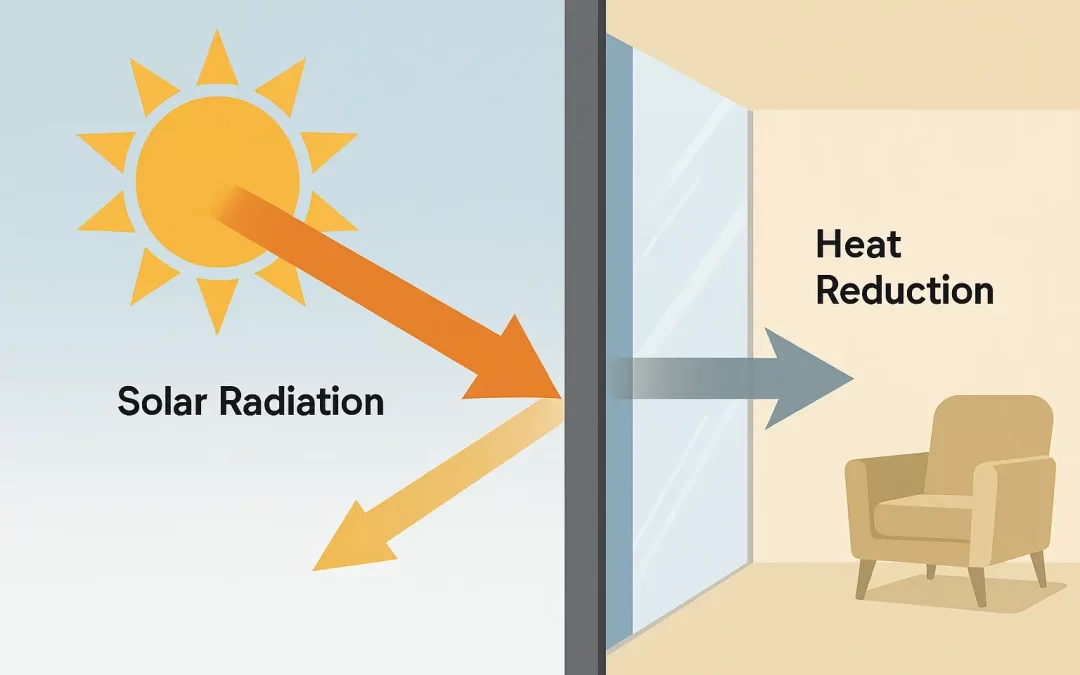
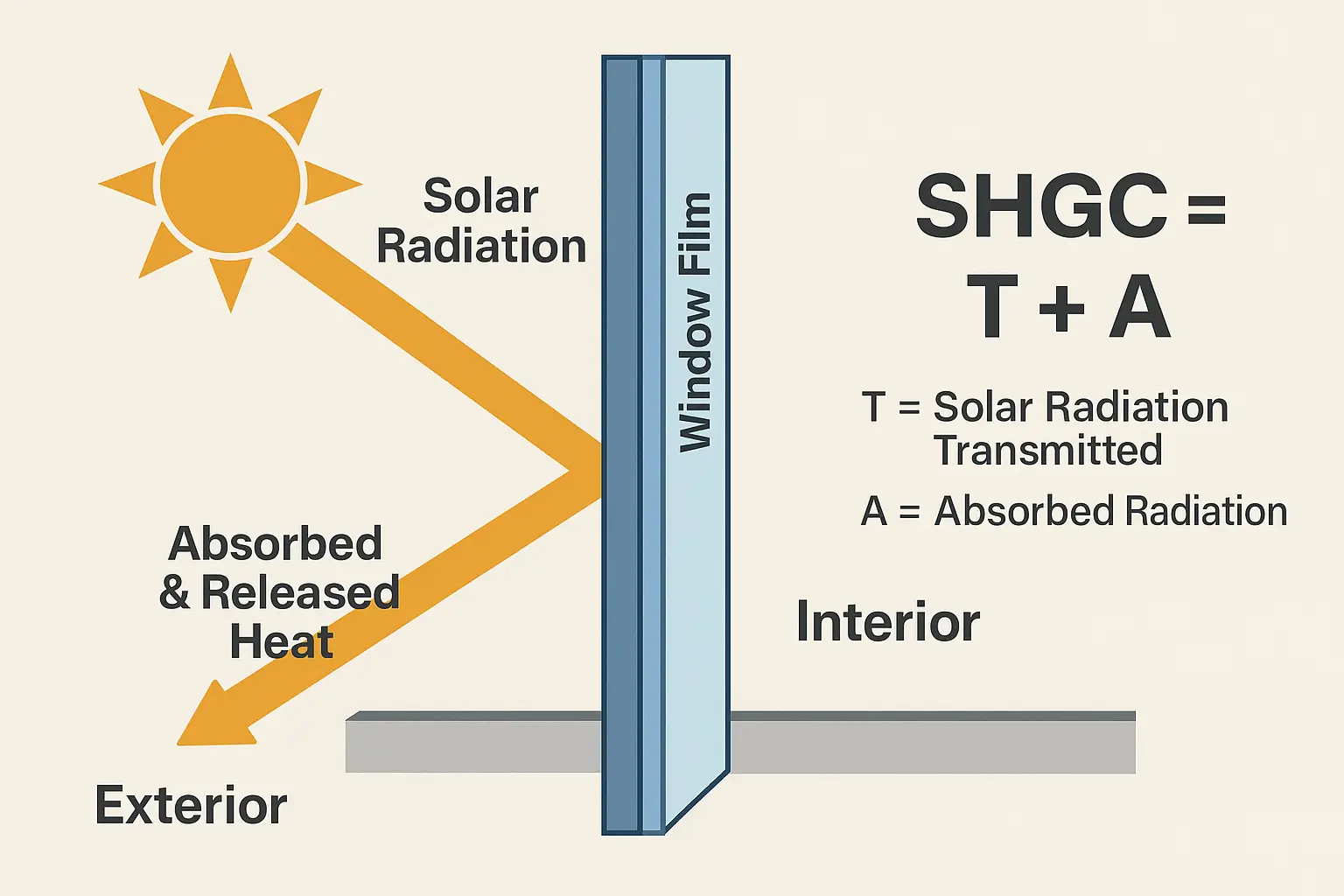
When sunlight hits a window, it does more than brighten the room. It also brings heat. That heat arrives in two ways: direct solar radiation that comes straight through the glass and indirect heat that the glass absorbs and then releases indoors. The Solar Heat Gain Coefficient, or SHGC, is one number that represents the total of both effects.
TL;DR:
Think of it as a fraction. If a window has an SHGC of 0.50, then about 50 percent of the sun’s total heat energy ends up inside. If it is 0.30, then about 30 percent gets in. The value accounts for visible sunlight and invisible infrared energy that drives room temperatures up.
How This Plays Out in Real Life
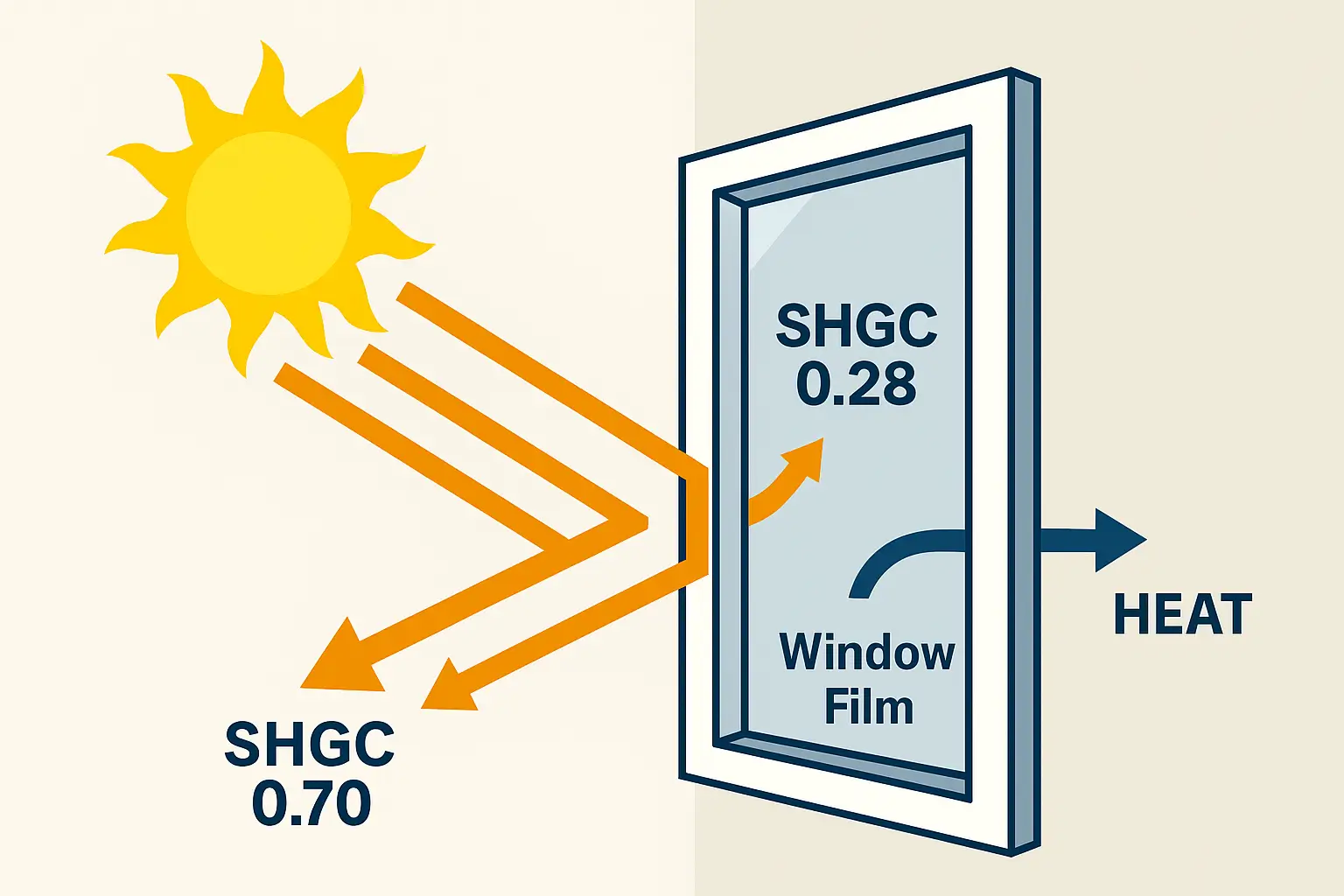
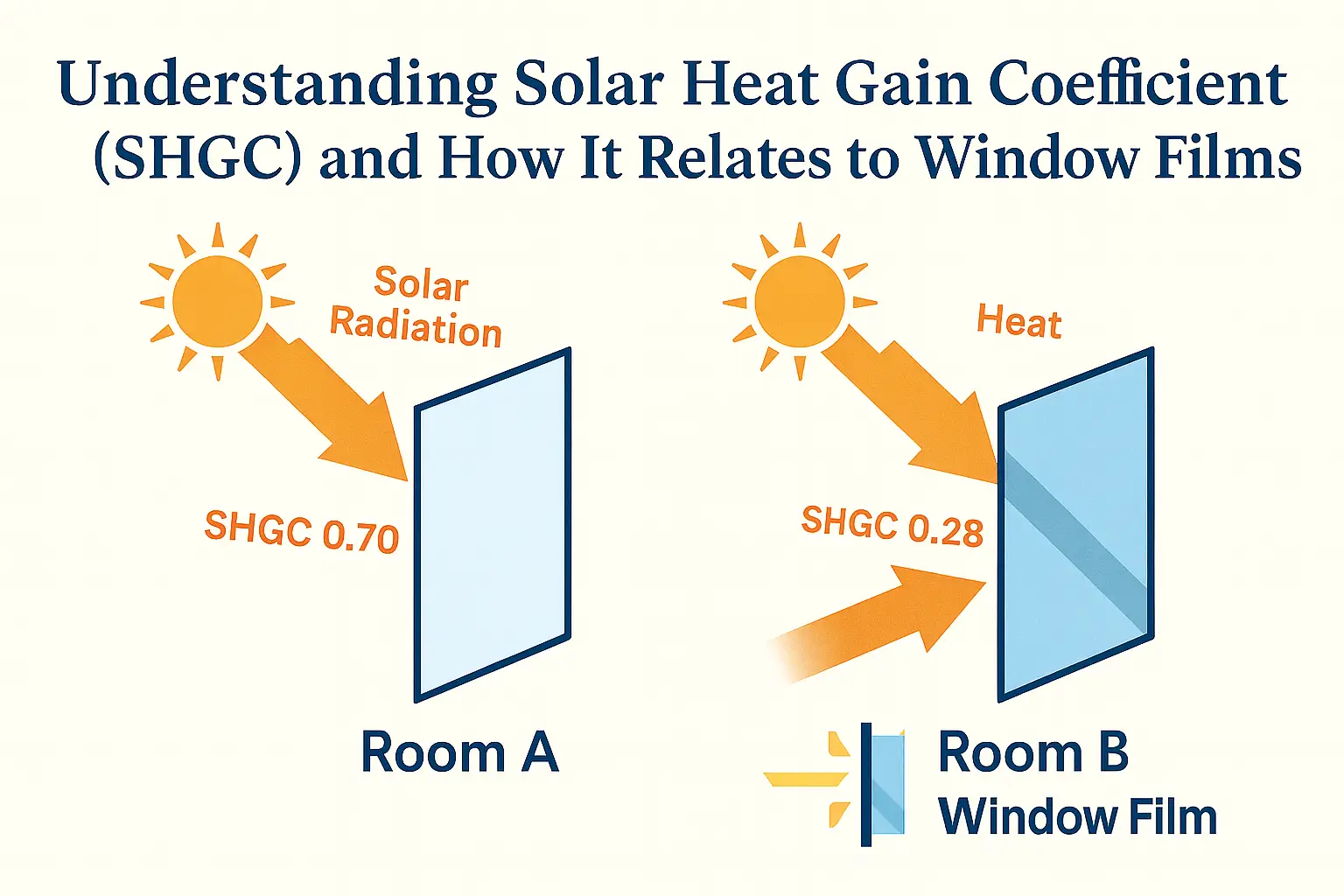
Imagine two identical living rooms with large south-facing windows.
- Room A: Clear, untreated glass with SHGC 0.70. On a sunny summer afternoon, the space overheats, the air conditioner runs longer, and furnishings see more UV stress.
- Room B: The same window with a high performance solar control film that drops SHGC to 0.28. Daylight is still pleasant, but the heat is cut by more than half. Sitting near the glass is comfortable and the AC cycles less often.
That change from 0.70 to 0.28 can translate into meaningful energy savings, especially in homes or offices with significant glass area.
Why Window Films Are a Game Changer for SHGC
You do not need full window replacement to change SHGC. The right window film can significantly reduce solar heat gain without touching the frame or glass unit. This matters because:
- It is a faster and more affordable upgrade. Films can deliver strong heat reduction at a fraction of the cost of new glazing.
- You can target problem exposures. Treat the west or south elevations that overheat the most while keeping a consistent look.
- You can balance for all seasons. Select films that limit summer heat yet still allow useful winter sun, especially on south facing windows.
Comparing SHGC Values Before and After Window Film
| Glass Type | SHGC Without Film | SHGC With Film | Heat Reduction Benefit |
|---|---|---|---|
| Clear single pane | 0.86 | 0.40 | Blocks over 50 percent of solar heat |
| Clear double pane | 0.70 | 0.35 | Blocks about 50 percent of solar heat |
| Tinted double pane | 0.61 | 0.28 | Blocks over 54 percent of solar heat |
| Low E double pane, standard | 0.40 | 0.25 | Additional 38 percent reduction |
| Low E double pane, high performance | 0.28 | 0.21 | About 25 percent additional reduction |
Note: Actual performance depends on film model, glass make up, and installation quality.
Seasonal Impact of SHGC With Window Films
Summer: Lower SHGC keeps interiors cooler and reduces cooling costs. If you usually close blinds to fight heat, a low SHGC film helps you keep the view without the hot spots.
Winter: Very low SHGC can reduce passive solar gain. Modern film choices can preserve some winter sun, especially on south facing glass, while still controlling summer heat.
SHGC in the Greater Toronto Area
The GTA has hot sunny summers and cold winters. A practical target is often SHGC 0.25 to 0.40. That range controls summer overheating while preserving useful daylight and some winter warmth.
- Example, west facing office in Vaughan: Aim for about 0.25 to reduce late day spikes.
- Example, south facing condo in downtown Toronto: Aim for about 0.30 to 0.33 for comfort in summer with some winter sun retained.
How SHGC Is Calculated
SHGC includes two parts: direct solar transmission that passes through the glass and secondary heat that the glazing system absorbs and then releases indoors. Laboratories and software, following National Fenestration Rating Council procedures, measure these contributions to produce the single SHGC number. Shoppers rarely compute SHGC themselves, but understanding what it represents helps when comparing films and window systems.
What Is a Good SHGC
- Hot or sunny climates: Lower SHGC, often 0.25 to 0.40 or less.
- Cold climates: Higher SHGC, often 0.50 and above to capture winter sun.
- Southern Ontario and the GTA: A balanced 0.25 to 0.40 is a smart starting point.
Is Lower or Higher SHGC Better
It depends on climate and goals. Lower is better for cooling dominated spaces. Higher can help in heating dominated locations. In mixed climates, choose a level that curbs summer heat without eliminating useful winter gain.
Is an SHGC of 0.27 Good
Yes for heat control. An SHGC of 0.27 is very low and strongly reduces solar heat. It is excellent for glare prone or west facing areas. It will also limit passive solar heating in winter, so consider exposure and usage before deciding.
Is G Value the Same as SHGC
Yes in practical terms. G value is the European term for the same total solar heat gain fraction. The values are directly comparable.
Does Low E Glass Make a Difference
Yes. Low emissivity coatings improve insulation and influence SHGC. Some Low E coatings are tuned to reflect more solar energy which lowers SHGC. Others allow more heat gain for colder climates. Review the specific coating data when pairing Low E glass with film.
What Do SHGC Values Mean
- 0.70 or higher: Very high heat gain with minimal solar control.
- 0.40 to 0.60: Moderate solar control that may suit cooler climates.
- 0.25 to 0.35: Strong heat rejection that fits sunny exposures or warmer seasons.
- Below 0.25: Maximum heat blocking used often in specialty or commercial applications.
What Is the Solar Heat Gain Coefficient for Cold Climate
Higher SHGC values, often 0.50 or more, can reduce heating loads by capturing solar warmth. Balance this with a low U factor for overall comfort and energy efficiency.
Energy Ratings, U Factor, and SHGC
SHGC deals with solar heat coming in. U factor measures how easily heat flows through the window due to temperature difference. Lower U factor is better. A U factor of 0.28 is strong for insulation. The ideal combination is a low U factor with an SHGC chosen for your climate and exposures.
Is T Solar the Same as G Value
No. T solar is the direct solar transmittance portion. G value or SHGC includes the direct portion plus the secondary heat released indoors. That is why G value and SHGC are always higher than T solar for the same system.
Disadvantages of Low E Glass Windows
Potential tradeoffs can include slightly reduced visible light, a subtle colour shift depending on coating, and an SHGC that may be too low or too high for your goals if the wrong coating is selected. Reviewing spectral data and pairing with the right film helps avoid these issues.
Which Side Should Low E Glass Face
In most Canadian double pane units, the Low E coating is on the interior surface of the outer pane. This position protects the coating and optimizes performance for both heating and cooling. Warm climate applications may use different placements to better reflect solar energy outward. Always follow the manufacturer specification for the exact glazing system.
Is Low E 366 Worth It
Low E 366 uses multiple layers to deliver very low SHGC while keeping visible light acceptance relatively high. It can be a good investment where strong heat rejection is needed without a dark interior. Window film can complement this glass when additional glare or UV control is desired.
Final Takeaway
SHGC is one of the most useful numbers to compare when choosing window films and glazing. It tells you how much solar heat will enter your space, which affects comfort and energy costs. Select a film that sets SHGC appropriately for your exposure and climate, and pair it with a low U factor where possible. The result is a more comfortable interior and a smaller energy bill across Toronto and the GTA.